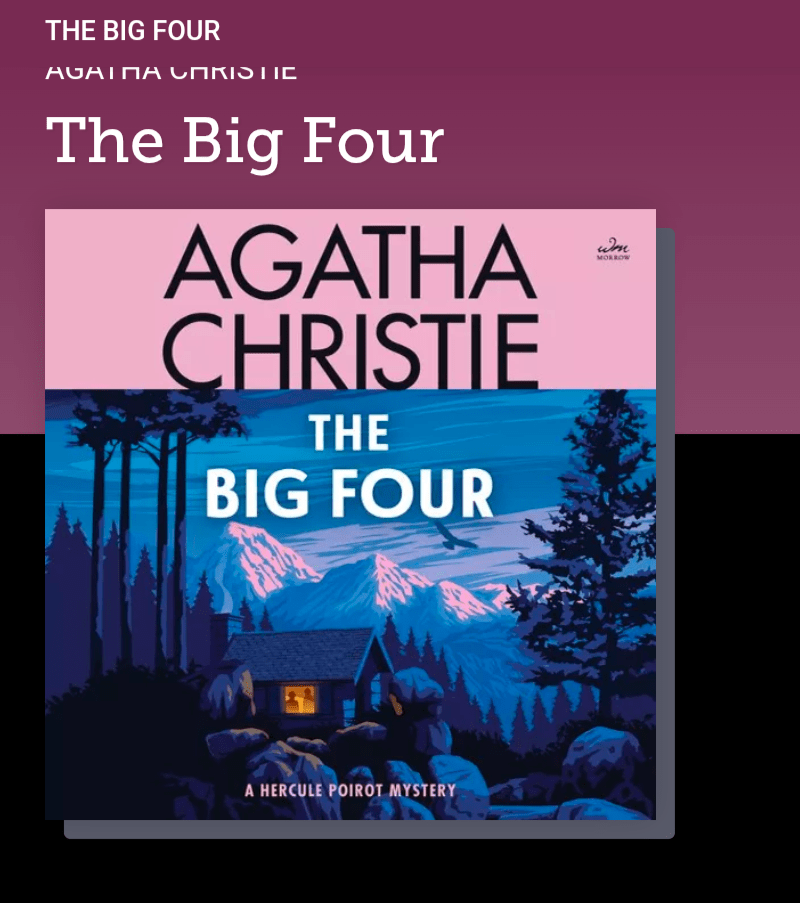
This was an interesting read for a variety of reasons. 1./ This was the first time in a while I’ve done an audiobook. After last year, where I read almost exclusively in paperback, I’m trying to mix things up between print, digital, and audio. 2./ Doing a little bit of online research, apparently the development of this story was a turbulent one. A lot of this research started with the wiki page, so you can check that out if you’re interested. Apparently this turbulent origin was the cause of some of the issues below. 3./ Despite everything it took to get this book through a publisher’s it’s still very good and worth giving a read.
The premise is: Hercule Poirot is reunited with his good friend Hastings, and together they pursue a criminal organization known as “the Big Four.” They are a shadowy and powerful group whose leader is a political (and all-around) genius from China. They seem to have infinite wealth, infinite reach, and the ability to insert themselves into any situation in order to see to it things come out their way.
What follows is a more episodic story of Poirot chasing down and exposing the Big Four. This will lead to Hastings infiltrating the household of one Big Four member, Poirot investigating another member’s research into nuclear energy, and other smaller mini-mysteries, all in pursuit of Poirot’s greatest adversary yet. Apparently, the episodic nature of the story came from Christie stringing together several smaller stories and giving them the common throughline of the Big Four.
This is probably Poirot at his most “Sherlockian” if that makes sense. He’s much meaner to Hastings in this one, and at times I felt really bad for the guy. He’s trying his best, but Poirot and the Big Four both have very nasty things to say about him. The book’s treatment of Chinese people and their culture is also pretty racist. Added onto that, Poirot also has a pretty inflated view of himself in this one (moreso than usual) to the point where it’s a bit off-putting. There’s also much less of that Poirot care and quirk in this one, relying more on gimmicks than on observations of the human condition.
That said, even at her worst, Christie is as good as it gets when it comes to this style of mystery. While it lacks some of the charm you’ll see in something like Murder on the Orient Express, it’s still a top notch mystery that kept me wanting to know more. Every gain made by Poirot and Hastings is dashed by a loss. A very “two steps forward, one step back” type of story that kept me satisfied enough to continue, but frustrated enough to stay engaged.
I listened to this entire book in one night, if that gives you an idea of how much I enjoyed this one. Definitely recommended.


Leave a Reply