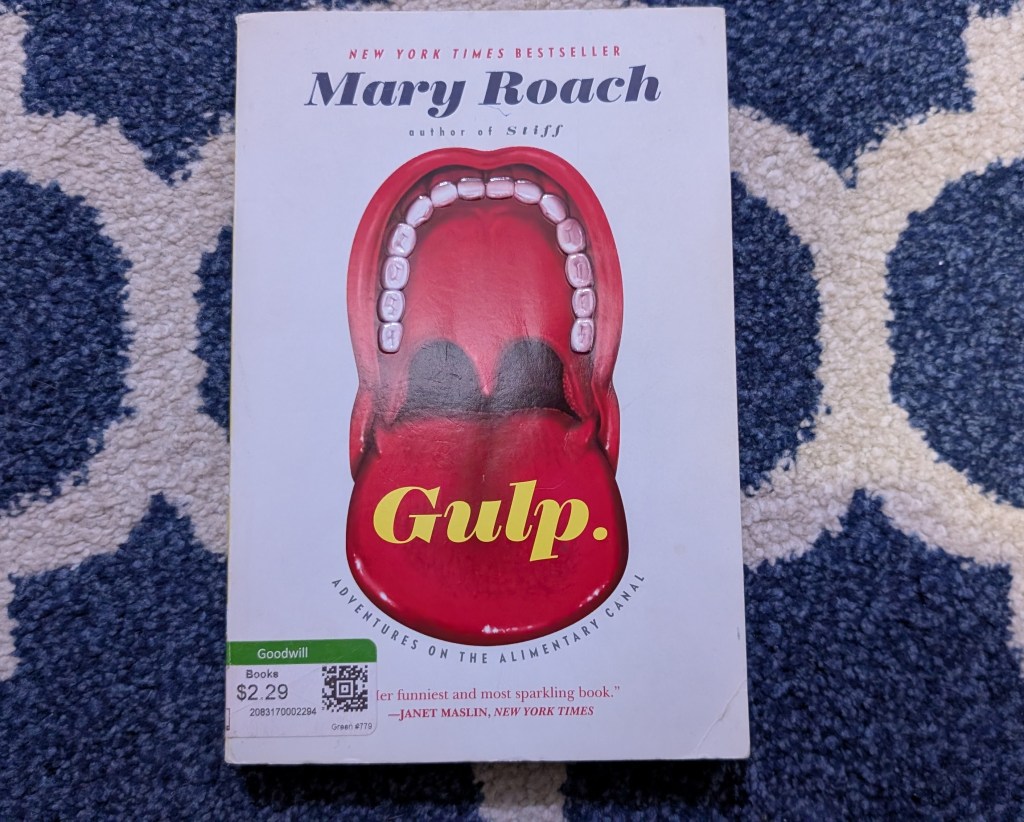
(Full disclosure: this is a catch-ups review. I read this back in December, but that month was a real whirlwind so I didn’t get around to writing this little review until now. Whoopsie!)
This is a new direction for my reading this year. I don’t typically read much science. Science Fiction? Sure. But straight up science? Not so much. I have an English Degree. The closest I’ve come to real science is the BIO-101 course I took as junior, and the cadaver still shows up in my nightmares on occasion. I say all this to give you an idea of the perspective I was bringing to this book. It’ll give you some context when I say: I really enjoyed this book. I don’t know if I’d go so far as to say I learned anything science-y from it, but I definitely had fun.
“Yes, men and women eat meals. But they also ingest nutrients. They grind and sculpt them into a moistened bolus that is delivered, via a stadium wave of sequential contractions, into a self-kneading sack of hydrochloric acid and then dumped into a tubular leach field, where it is converted into the most powerful taboo in human history”
–Gulp
The premise is, the author is using the digestive tract of the human body, starting at the nose and mouth and ending…on the other side. Each stop along the way, she tells some fun or informative little tidbits regarding that part of the alimentary canal. Some of this is more “fun trivia,” such as how most dry pet food is completely flavorless except for the weird dust that you find on all the little bits of kibble. (Apparently, the recipes for this dust is a closely guarded secret, and there are any number of human specialists who taste pet food and determine if it’s good.)
“People pooh-pooh [Budweiser]. It’s an extremely well-made beer. It’s clean, it’s refreshing. If you’re mowing the lawn and you come in and you want something refreshing and thirst-quenching, you wouldn’t drink this.” She indicates the IPA.
Sue Langstaff, sensory consultant, Gulp
We also learn about what it’s like being a professional beer taster, not as a critic like some lucky jerks, but as a quality control specialist. This has less to do with determining whether or not a beer is “good” but rather if it’s consistent. While building a brand in food and beverage (in this case beverage) it’s important for your first beer to taste like your 50th beer, to taste like your 500th beer. Specialists like Sue (quoted above) make sure that happens. I already knew a bit about this, but it was interesting seeing how it works from an expert.
As a member of a culture that demonizes bacteria in general and the germs of other people in specific, you may find it disturbing to imagine checking into a hospital to be implanted with bacteria from another person’s colon. For the patient I’ll shortly be meeting, a man invaded by Clostridium difficile, it’s a welcome event.
But we can’t spend the entire book in the mouth talking about taste and smell, so we do descend deeper into the guts, talking about the stomach capacity of professional eaters, as well as the…erm…bowel capacity of certain unfortunates down through history. This includes (allegedly) Elvis Presley, who may or may not have passed away partially due to intestinal issues. We get into people who use their orifices to smuggle illegal goods (no pun intended), people who have eaten themselves to death, and fecal transplants.
“How is it that we find Christina Aguilera more interesting than the inside of our own bodies? It is, of course, possible that I seem strange. You may be thinking, Wow, that Mary Roach has her head up her ass. To which I say: Only briefly, and with the utmost respect.”
While at times, the book can get a little bit gross, Roach does a fantastic job of keeping it light and airy, with a certain sense of lightly perverse glee. She knows this stuff is gross, and that’s what makes it fun. That joy comes through in the writing. So for what it’s worth, if you’re looking to get into science writing but you’re not sure where to start, you can’t really go wrong starting here. I’m looking forward to reading Stiff. Definitely recommended.
 HodrosBooks
Leave a comment