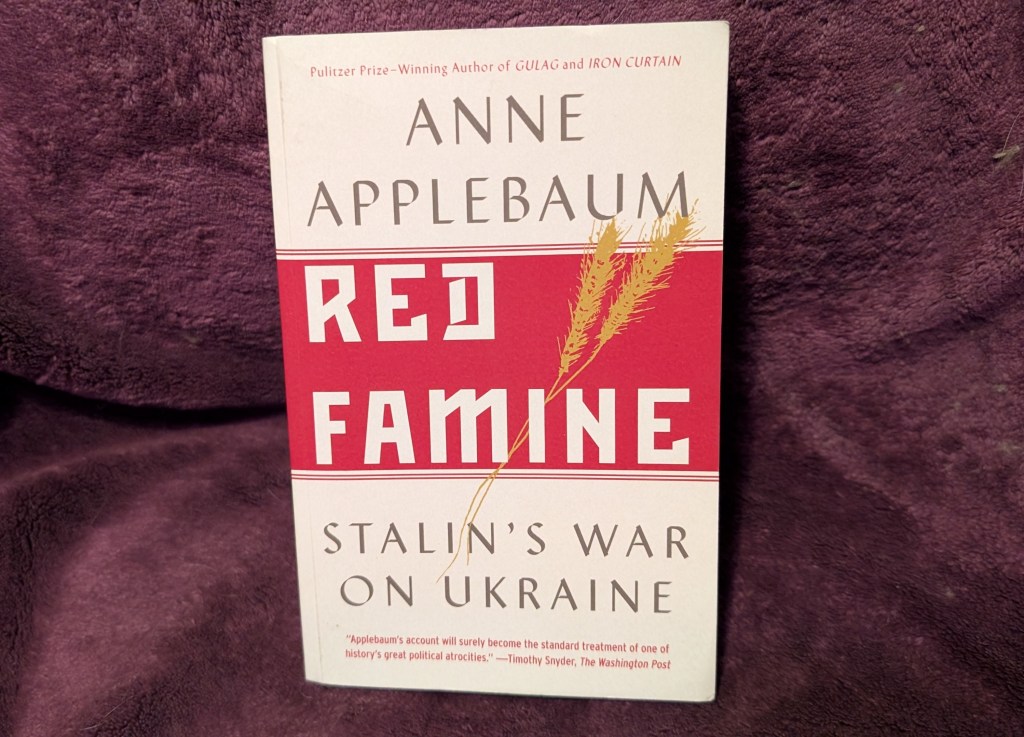
I’ve had this book on my to-read list for a while. The timing wasn’t great, as things here in the States are about to get pretty grim for the next four years, but it’s a piece of history I knew very little about. For anyone unfamiliar with this book, it’s the history of what’s known in Ukraine as “Holodomor,” or the Great Ukrainian Famine, which took place from 1932-33. Translated, it literally means “Death by Hunger.”
[Stalin] was deeply concerned about the Ukrainian party’s reliability. Using language that illustrates how far the Soviet state had gone in the direction of personal tyranny, he told [party leadership] that the local leaders were insufficiently loyal.
–Red Famine
As you can guess, it’s a pretty grim history. It begins in the 1910’s. Following the Russian Revolution and the fall of the Tsar, there was a push for Ukrainian nationalism and an identity independent of Russia and the new USSR. Things under the Tsar weren’t super awesome (to put it lightly) and things under the Soviets weren’t looking to be any better. Many in Russia (and the rest of Europe) considered Ukraine less as its own nation or country, and more as “Little Russia” but the people of Ukraine were looking to change that. Ukrainian intelligentsia began pushing for education in Ukrainian (previously, it was only legal to teach in Russian). They were also chronicling Ukrainian history independently of Russia for the first time, as well as growing Ukrainian culture and arts revolving around Ukrainian artists, writers, and thinkers. That push for nationalism was eventually crushed by Lenin, aided in part by another lesser famine that came about as a result of Soviet grain requisitions and a bad farming season.
The destruction of [Ukrainian] buildings was accompanied by an attack on the people who understood them best: a whole generation of art historians and curators. People who had dedicated their lives to the causes of art and knowledge met horrifying ends.
That vein of nationalism and independence remained, which Applebaum argues led to harsher and harsher grain and food requisitions until it led to every last speck of food being stolen from Ukraine and exported back to Russia. This kicked off the Holodomor, which resulted the deaths of between 4 and 5 million Ukrainians. Applebaum goes on to explain that, in the legal sense of the word, this does not constitute a genocide as defined by the UN. Conveniently, Stalin’s Russia had a hand in writing that definition.
Several sets of directives…on requisitions, blacklisted farms and villages, border controls and the end of Ukrainization—along with an information blockade and extraordinary searches, designed to remove everything edible from the homes of millions of peasants—created the famine now remembered as the Holodomor.
Apparently, there’s a debate on regarding whether or not this was a deliberate famine, or if it was just one of those things that happen. Applebaum argues that it was absolutely deliberate, and the evidence presented is pretty hard to refute, considering that much (if not all) of it comes from USSR documentation made available since the collapse, or from first-hand accounts given by survivors. But I’ve only read one book on the topic so far, and I don’t want to present myself as an expert. Read this and judge for yourself, I’ll bet we wind up on the same side of the argument.
Stalin’s policies… led inexorably to famine all across the grain-growing regions of the USSR. But in November and December 1932 he twisted the knife further in Ukraine, deliberately creating a deeper crisis. Step by step, using bureaucratic language and dull legal terminology, the Soviet leadership, aided by their cowed Ukrainian counterparts, launched a famine within the famine, a disaster specifically targeted at Ukraine and Ukrainians.
Anyway, it’s a chilling recounting of negligent and incompetent leadership that eventually turns into malicious mishandling of resources for the sole purposes of making people suffer and die. A rough read, especially at the moment, but I still recommend it. It really shines a light on the 20th century, and gives you an idea of why things are happening the way they are today. Definitely recommended.
All through the previous two years these uncouth, illiterate, backward and ultimately redundant inhabitants of the countryside had been firmly and repeatedly accused of blocking the progress of the forward-looking proletariat. Over and over again Soviet newspapers had explained that food shortages in the cities were not caused by collectivization, but rather by greedy peasants who were keeping their produce to themselves.
 HodrosBooks
Leave a comment