
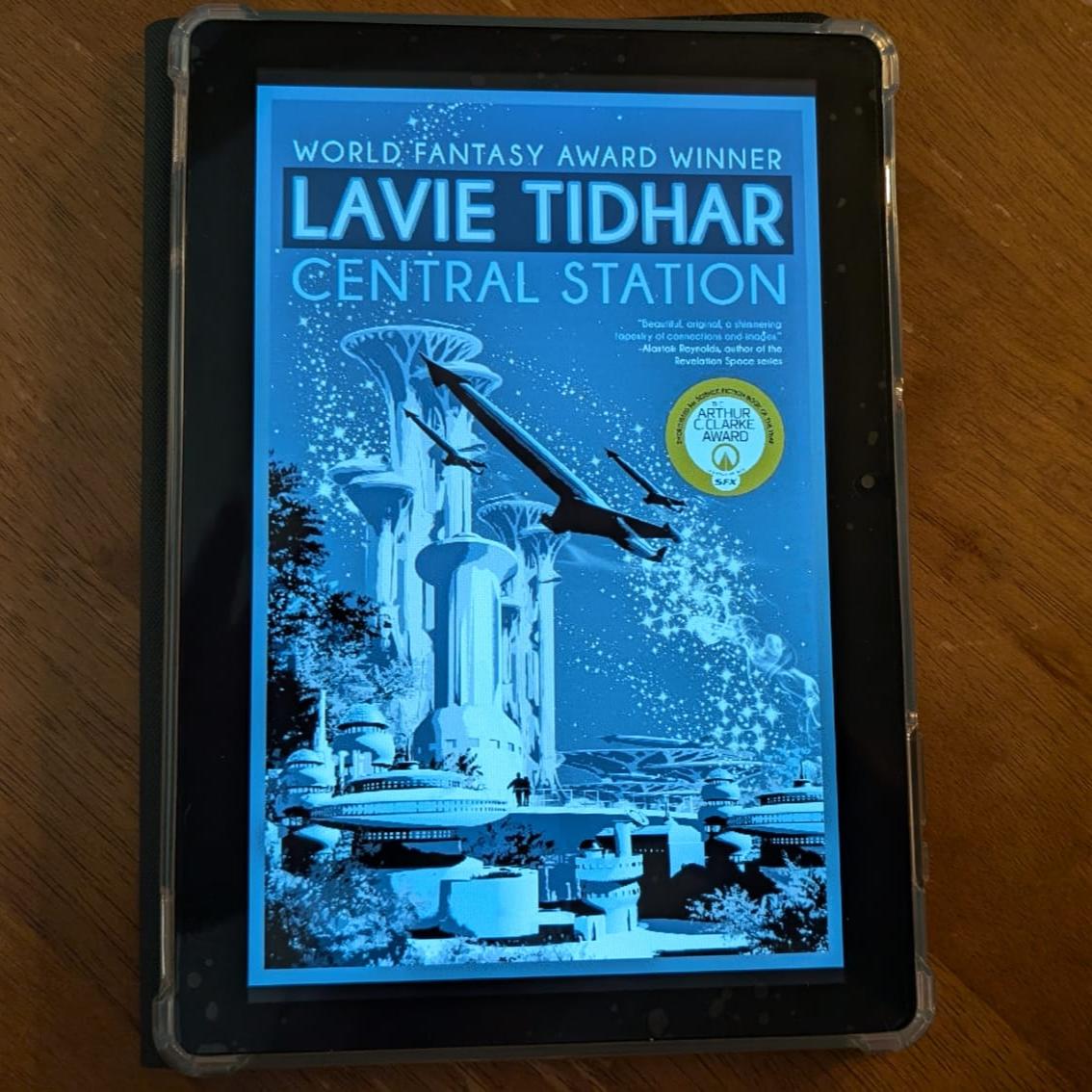
This past week, at a writers’ accountability meeting, a friend of mine recommended that I give this a read. I was asking about a concept that (for some reason) I struggle to describe in a succinct way: A book series with a set world but different casts of characters. Picture Middle Earth, but instead of always going back to the Bagginses, we spend time with a different adventuring party doing different things completely unrelated to the One Ring. The entire concept of Dungeons and Dragons hinges on this idea, so it seems natural that books should occasionally go in that direction. And yet I have a hard time finding it (recommendations welcome, hit me up at hodrosboos@gmail.com).
[This was] not the endless scrolls of text and images, moving and static, nor full-immersion narratives he understood other people to experience, in what he called, in his obsolete tongue, the networks, and others called, simply, the Conversation. Not those, to which he, anyway, had no access. Nor were they books as decorations, physical objects handcrafted by artisans, vellum-bound, gold-tooled, typeset by hand and sold at a premium.
–Achimwene, upon finding a treasure trove of paperback fiction, Central Station
Anyway, the premise of Central Station is: in the far future, a spacesport has been built on the site of the busport between Tel Aviv and Jaffa in the Middle East. The already culturally diverse area has exploded with culture, some of it literally alien. There are Jewish and Arabic locals, Chinese and Russian immigrants, up-and-outers (people from outer space), and Martians (humans who have lived on Mars). On top of that, there are cyborgs, robots, robotniks, completely digital beings called “others” and so on. The cultural mishmash was a great deal of the interest for me. There’s Judaism, Christianity, Islam, Elronism (a future variant of scientology), the Church of Robot...I doubt I'm remembering everything But even the most mundane of the mundane has a twist: most of humanity is born with a “node,” which is a sort of biological computer that gives one access to the digital realm. Those without are considered disfigured or deformed because they miss out on half of what life has to offer.
This is the kind of science fiction I used to dream about when I was a kid. It’s not trying to be Star Trek. It’s not trying to be Star Wars. It’s its own thing, and it’s grounded in the kind of dusty, grungy, dirty reality that I would expect from the far future. It’s not dystopian. There hasn’t been some great disaster. Life is just messy, and this is the story of a group of people trying to get by and live a comfortable life. The digital world isn’t the matrix. It’s spoken of almost with a sort of reverent, spiritual tone. People who are skilled in the digital world are treated like priests, wizards, angels, or even monsters.
The shelves inside were arranged by genre. Romance. Mystery. Detection. Adventure. And so on.
–Achimwene, describing his library, Central Station
Life wasn’t like that neat classification system, Achimwene had come to realise. Life was half-completed plots abandoned, heroes dying halfway along their quests, loves requited and un-, some fading inexplicably, some burning short and bright. There was a story of a man who fell in love with a vampire. . .
The characters are relatable and melancholy. Boris Chong has returned to Earth to care for his ailing father Vlad, but he’s also returned to see if he can rekindle something with his childhood sweetheart, Miriam. Miriam is trying to get by as a community leader and adopted mother of Kranki, who may or may not be a genetically grown messiahboy from the birthing tanks of Central Station. Boris’s fling-from-beyond-the-stars, Carmel, has also returned to Earth to find him and maybe get help with her affliction, which I won’t spoil here because discovering it was rad.
If you’re looking for an overarching plot, an answer to the question “What’s the main quest?” you won’t get it. This is a tableau piece. You’re supposed to drink in the atmosphere of an interesting place and lose yourself in the hustle and bustle of the Central Station itself. I haven’t touched on half the plotlines. I’ve quoted sections from Achimwene’s story, and I haven’t discussed him at all. He was my favorite, and I don’t want to spoil for you. As you learn about this location, you learn about how the people are tied to it in one way or another. Even Boris, who had tried to escape, is inexorably drawn back. This is the story of how a mishmash of so many cultures and peoples becomes its own thing. “Multiculturalism” is its own culture, precious in its variety.
Had he been the hero of one of the books he so avidly collected, he would have held a gun at this point. But Achimwene never learned to fight: a gun was as alien to him as a compliment..
–Central Station
Anyway, fantastic read. Can’t wait to read the next in the series. Definitely check it out.
 HodrosBooks
Leave a comment